
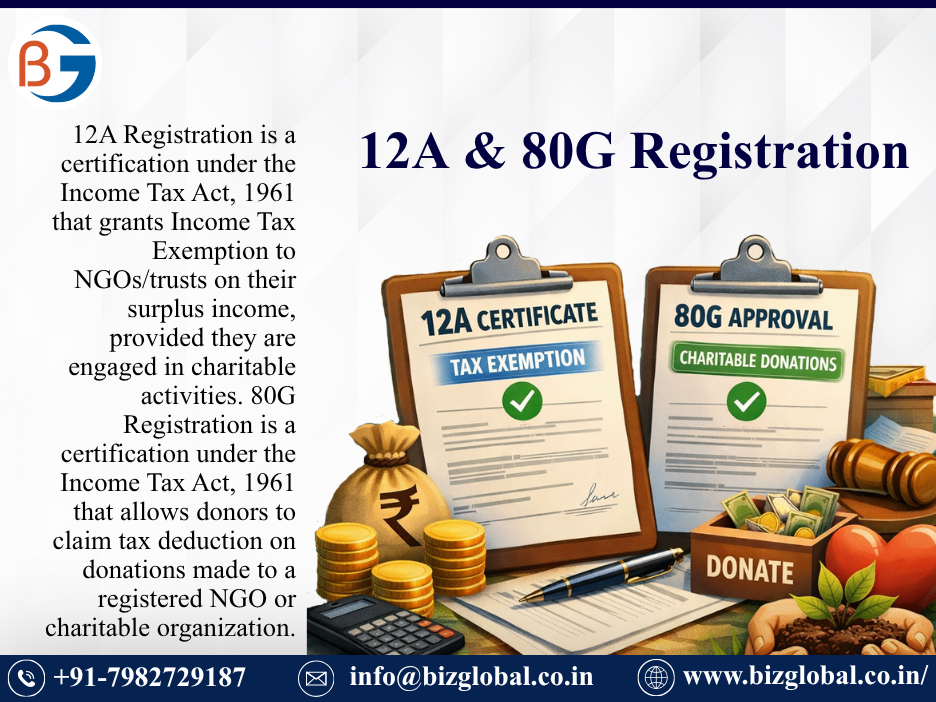
For NGOs, Trusts, Societies, and Section 8 Companies, obtaining 12A and 80G Registration is one of the most important steps toward achieving financial sustainability, tax efficiency, and donor confidence. These registrations provide tax benefits to both charitable organizations and their donors, making them essential for fundraising and long-term growth.
Whether your organization is newly established or already engaged in charitable activities, securing 12A and 80G Registration can significantly improve your ability to attract donations, grants, CSR funding, and institutional support.
What is 12A Registration?
12A Registration is a certification granted under the Income Tax Act, 1961 that provides income tax exemption to charitable organizations on their surplus income.
Once registered under Section 12A, the income earned by an NGO through donations, grants, or charitable activities is generally exempt from income tax, provided it is utilized for approved charitable purposes.
In simple terms:
12A Registration helps the NGO save tax on its income.
What is 80G Registration?
80G Registration is a certification under the Income Tax Act, 1961 that allows donors to claim tax deductions on donations made to eligible charitable organizations.
This tax benefit encourages individuals and corporates to contribute to NGOs and charitable institutions.
In simple terms:
80G Registration helps donors save tax on their donations.
Why 12A & 80G Registration is Important?
1. Tax Exemption for NGOs
12A Registration helps charitable organizations retain more funds by reducing their tax liability.
2. Tax Benefits for Donors
80G Registration enables donors to claim deductions on eligible donations, making fundraising easier.
3. Increases Credibility
Organizations with 12A and 80G registrations are generally viewed as more trustworthy and compliant.
4. Improves Funding Opportunities
Many CSR contributors, grant providers, and institutional donors prefer supporting organizations with these registrations.
5. Supports Long-Term Sustainability
Tax savings and increased donations help organizations expand their social impact and operations.
6. Facilitates Compliance
These registrations help establish the organization's legal recognition as a charitable institution under the Income Tax framework.
Who Needs 12A & 80G Registration?
The following entities commonly apply for 12A and 80G Registration:
- Charitable Trusts
- Public Religious Trusts serving public benefit
- Registered Societies
- Section 8 Companies
- Educational Institutions
- Medical Relief Organizations
- NGOs engaged in charitable activities
- Welfare and social development organizations
Who is Not Eligible?
Generally, the following entities are not eligible:
- For-profit companies
- Political parties
- Organizations established primarily for private benefit
- Entities whose activities do not qualify as charitable under applicable laws
Understanding the Difference Between 12A and 80G
While both 12A and 80G registrations are vital for charitable organizations in India, they serve distinct purposes and impact different stakeholders.
12A registration is designed primarily to benefit the organization itself. When an NGO secures 12A status, it becomes eligible for tax exemptions on its income, meaning the surplus funds generated by the organization are not subject to income tax. This exemption is crucial for ensuring the NGO's long-term financial sustainability by allowing it to retain more of its resources for its charitable activities.
80G registration, conversely, is focused on the donor. This status allows donors who contribute to the NGO to claim a tax deduction on their donations, effectively reducing their taxable income. This acts as a significant incentive, encouraging more people and entities to support the organization. Because 12A registration strengthens the NGO’s internal financial health and 80G registration boosts its external fundraising potential, most NGOs aim to obtain both certifications simultaneously to maximize their overall impact.
Benefits of 12A & 80G Registration
Financial Benefits
- Exemption from income tax on eligible surplus income
- Increased donation inflow
- Improved financial sustainability
- Better fundraising opportunities
Growth Benefits
- Easier access to CSR funding
- Improved eligibility for grants
- Better opportunities for international funding (subject to FCRA compliance)
- Enhanced donor confidence
Branding and Trust Benefits
- Improved credibility among donors
- Stronger public image
- Better partnership opportunities
- Increased organizational transparency
Legal Benefits
- Recognition as a charitable institution
- Compliance with income tax regulations
- Reduced risk of tax-related disputes
Documents Required for 12A & 80G Registration
Basic Documents
- Trust Deed, MOA, or AOA
- Registration Certificate of Trust, Society, or Section 8 Company
- PAN Card of the NGO
- Registered Office Address Proof
- Aadhaar and PAN of Trustees, Directors, or Members
- Bank Statement
Financial Documents
- Audited Financial Statements (Last Three Years, if available)
- Income and Expenditure Statements
- Balance Sheets
Activity Documents
- NGO Activity Report
- Project Details
- Details of Charitable Activities Undertaken
Additional Documents
- Donor List
- NGO Darpan Registration Details
- FCRA Registration Certificate (if applicable)
- Previous 12A or 80G Certificate (for renewal cases)
Important Compliance Requirements
1. Apply Income for Charitable Purposes
A substantial portion of the organization's income should be utilized for charitable activities in accordance with applicable provisions.
2. Maintain Proper Books of Accounts
Organizations should maintain transparent financial records and supporting documentation.
3. File Annual Income Tax Returns
Eligible organizations are generally required to file annual returns, even if no tax is payable.
4. Avoid Private Benefit
Funds should not be used for personal benefit of trustees, directors, or related parties beyond legitimate and reasonable transactions.
5. Maintain Registration Validity
Organizations should monitor registration validity and apply for renewal within the prescribed timelines.
6. Maintain Donation Records
Proper donor records and donation documentation should be maintained to support compliance requirements.
Best Practices for NGOs
- Apply for 12A and 80G immediately after formation.
- Maintain accurate financial statements and audit records.
- Keep donor databases updated.
- Document charitable activities regularly.
- Ensure transparency in governance and fund utilization.
- Build long-term fundraising strategies using tax benefits as a donor incentive.
How  Can Help You?
At BizGlobal, we provide complete assistance for obtaining 12A and 80G Registration for Trusts, Societies, NGOs, and Section 8 Companies.
Our services include:
- Eligibility assessment and compliance review
- Documentation preparation and verification
- Application filing and representation
- Trust, Society, and Section 8 Company support
- NGO Darpan registration assistance
- FCRA and CSR compliance guidance
- Renewal and modification assistance
- Ongoing NGO compliance advisory
Our experts ensure a smooth registration process and help your organization become donor-ready while maximizing compliance benefits.
Frequently Asked Questions (FAQs)
1. Is 12A Registration mandatory for NGOs?
While not mandatory for existence, 12A Registration is highly beneficial as it provides income tax exemption on eligible income earned by the NGO.
2. Why should an NGO obtain 80G Registration?
80G Registration allows donors to claim tax deductions on donations, making fundraising significantly easier for the organization.
3. Can a newly formed NGO apply for 12A and 80G Registration?
Yes. Newly established NGOs can apply for registration and may be eligible for provisional registration subject to applicable requirements.
4. Can an NGO have 12A Registration without 80G Registration?
Yes. However, obtaining both registrations together generally provides maximum benefits for the organization and its donors.
5. Does 12A and 80G Registration help in getting CSR funding?
Yes. Many corporate donors and CSR contributors prefer supporting organizations that possess valid 12A and 80G registrations.
Conclusion
12A and 80G Registration are among the most valuable tax and compliance certifications for NGOs and charitable organizations in India. Together, they provide tax efficiency, improve donor confidence, strengthen fundraising capabilities, and establish credibility with stakeholders, grant providers, and corporate donors.
Organizations seeking sustainable growth and long-term impact should prioritize obtaining these registrations at the earliest opportunity and maintain proper compliance thereafter.
Contact: +91-7982729187 and get your 12A Registration, 80G Registration, NGO Compliance, CSR Readiness, and Funding Support managed professionally by BizGlobal today.