
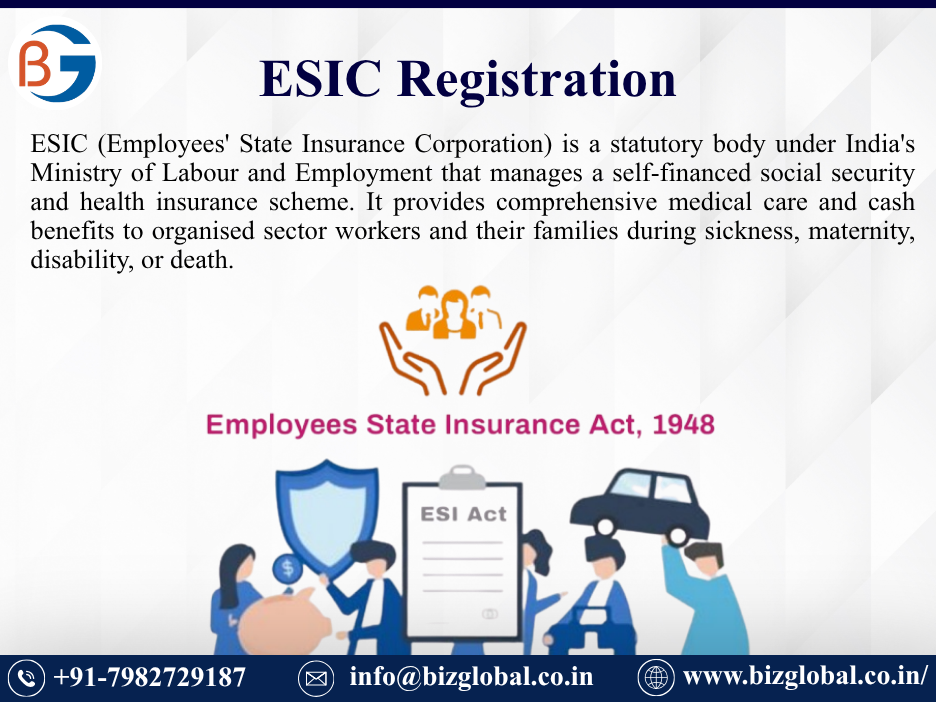
Employee welfare is one of the most important responsibilities of every employer. To ensure that workers and their families receive financial and medical support during times of need, the Government of India introduced the Employees' State Insurance (ESI) Scheme, administered by the Employees' State Insurance Corporation (ESIC).
ESIC registration is a crucial labour law compliance for eligible establishments and provides employees with comprehensive social security benefits, including medical care, maternity benefits, disability compensation, and financial assistance during sickness.
Whether you are a startup, factory, shop, restaurant, service provider, or growing business, understanding ESIC registration requirements is essential for maintaining legal compliance and employee welfare.
What is ESIC Registration?
The Employees' State Insurance Corporation (ESIC) is a statutory body functioning under the Ministry of Labour and Employment, Government of India.
The ESI Scheme is a self-financed social security and health insurance program designed to provide medical and financial benefits to employees and their dependents in cases of:
- Sickness
- Maternity
- Employment injury
- Disability
- Death due to employment-related causes
Eligible employers are required to register under ESIC and make periodic contributions for covered employees.
Why ESIC Registration is Important?
1. Legal Compliance
ESIC registration is mandatory for establishments covered under the Employees' State Insurance Act, 1948.
2. Employee Welfare
The scheme provides medical treatment and financial support to employees and their families.
3. Financial Protection
Employees receive cash benefits during periods of illness, maternity leave, disability, or employment-related injury.
4. Enhanced Employer Credibility
Compliance with labour laws demonstrates the employer's commitment to employee welfare and responsible business practices.
5. Avoid Heavy Penalties
Failure to obtain ESIC registration or deposit contributions can lead to penalties, interest, and legal action.
Who Needs ESIC Registration?
ESIC registration generally applies to:
- Businesses employing 10 or more employees (threshold may vary by state)
- Factories and manufacturing units
- Shops and commercial establishments
- Hotels and restaurants
- Cinemas and entertainment establishments
- Service sector organizations
- Startups crossing the employee threshold
- Contractors employing eligible workers
The scheme generally covers employees earning up to ₹21,000 per month, subject to applicable rules and amendments.
Benefits of ESIC Registration
Medical Benefits
- Comprehensive medical care for employees and their families
- Hospitalization and treatment facilities
- No prescribed upper limit on medical expenses under eligible treatment
Cash Benefits
- Sickness benefits during certified illness
- Compensation for wage loss during periods of incapacity
- Long-term sickness benefits for specified diseases
Maternity Benefits
- Paid maternity leave benefits
- Financial assistance during pregnancy and childbirth
- Medical support for maternity-related treatment
Disability Benefits
- Temporary disability compensation
- Permanent disability benefits
- Financial assistance for employment-related injuries
Dependent Benefits
- Pension and financial support to dependents in case of employment-related death
Additional Benefits
- Funeral expenses assistance
- Vocational rehabilitation programs
- Unemployment allowance under eligible schemes
- Rehabilitation support for injured workers
Documents Required for ESIC Registration
The following documents are generally required:
Business Registration Documents
- Certificate of Incorporation (Company)
- LLP Agreement
- Partnership Deed
- Trust Deed
- Memorandum and Articles of Association (MOA & AOA)
Identity Documents
- PAN Card of Proprietor, Partner, Director, or Authorized Signatory
- Aadhaar Card of Proprietor, Partner, Director, or Authorized Signatory
Address Proof
- Utility bill or other valid address proof not older than two months
- Registered office address proof
Banking Documents
- Cancelled cheque
- Bank statement of the establishment
Additional Documents
- Digital Signature Certificate (DSC)
- Rent or Lease Agreement (if premises are rented)
- Employee details including:
- Name
- Father's Name
- Date of Birth
- Date of Joining
- Aadhaar Number
- PAN Number
- Bank Account Details
- Salary Information
- Date of commencement of business
- Date on which the employee threshold was crossed
- Passport-size photographs of employees
- Family details and nomination information
Important ESIC Compliance Points
1. Register Without Delay
ESIC liability starts from the date the establishment becomes eligible, not from the date of registration.
2. Enroll Employees Promptly
New eligible employees should be enrolled immediately upon joining to ensure uninterrupted benefits.
3. Accurate Wage Calculation
ESIC contributions should be calculated on applicable wages as prescribed under the law.
4. Maintain Updated Employee Records
Employee and family details should be updated regularly to avoid claim-related issues.
5. Ensure Timely Contribution Payments
Delayed payments can result in interest, penalties, and legal consequences.
How  Can Help You?
At BizGlobal, we provide comprehensive ESIC registration and labour law compliance services for startups, SMEs, and established businesses.
Our services include:
- Eligibility assessment and compliance review
- ESIC registration and employer code generation
- Employee enrollment assistance
- Documentation and application support
- Pehchan Card registration guidance
- Contribution calculation support
- ESIC return filing assistance
- Labour law compliance advisory
- Ongoing compliance management
Our experts ensure hassle-free registration, timely compliance, and complete support throughout the ESIC lifecycle.
Frequently Asked Questions (FAQs)
1. Is ESIC registration mandatory for all businesses?
No. ESIC registration is generally mandatory for establishments employing 10 or more employees, subject to state-specific applicability provisions.
2. Which employees are covered under the ESI Scheme?
Generally, employees earning up to ₹21,000 per month are covered under the scheme, subject to prevailing regulations.
3. What benefits do employees receive under ESIC?
Employees receive medical benefits, sickness benefits, maternity benefits, disability compensation, dependent benefits, and other welfare benefits.
4. What happens if an employer does not register under ESIC?
Failure to register may result in penalties, interest, prosecution, and recovery proceedings under the Employees' State Insurance Act.
5. Can family members of employees avail ESIC benefits?
Yes. Eligible family members of insured employees can avail medical facilities and certain other benefits under the ESI Scheme.
Conclusion
ESIC registration is a vital compliance requirement that protects both employers and employees. Beyond legal compliance, it provides a robust social security framework that supports employees and their families during medical emergencies, maternity, disability, and other unforeseen circumstances.
Businesses that comply with ESIC regulations demonstrate a commitment to employee welfare while safeguarding themselves from penalties and legal risks. As your workforce grows, ensuring timely ESIC registration becomes an essential step in building a compliant and employee-friendly organization.
Contact: +91-7982729187 and get your ESIC Registration, Employee Enrollment, Return Filing, and Labour Law Compliance managed professionally with BizGlobal today.