
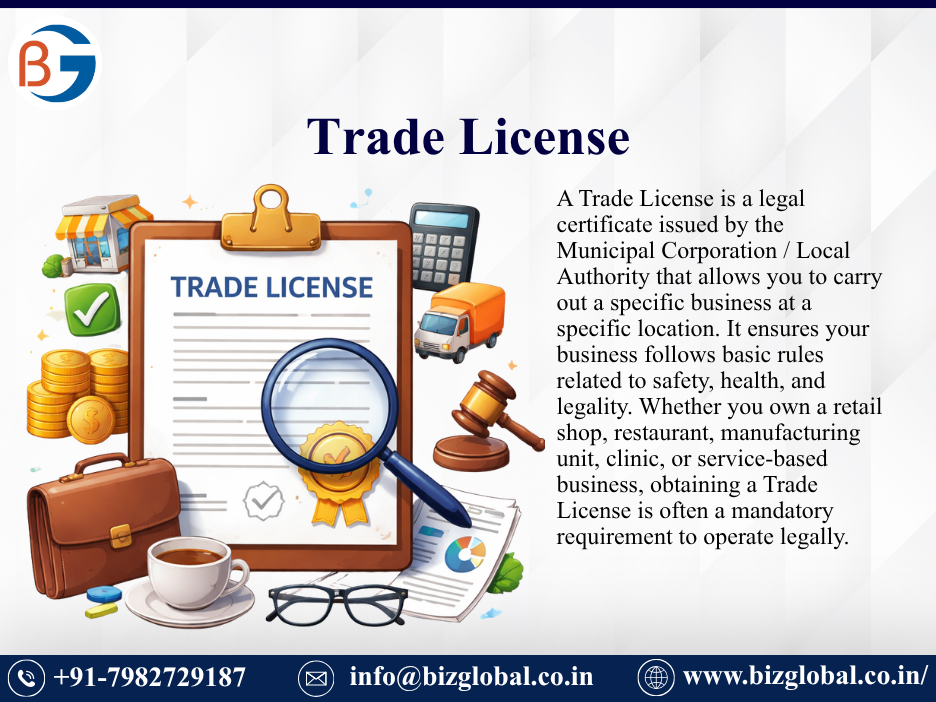
Starting a business involves more than just registering your company and setting up operations. One of the most important local compliances that many businesses overlook is obtaining a Trade License. This license serves as legal permission from the local municipal authority to conduct a specific business activity at a particular location.
Whether you own a retail shop, restaurant, manufacturing unit, clinic, or service-based business, obtaining a Trade License is often a mandatory requirement to operate legally.
What is a Trade License?
A Trade License is a certificate issued by the Municipal Corporation or Local Authority that authorizes a business to carry out a specified commercial activity at a designated location. The primary objective of this license is to ensure that businesses comply with local regulations relating to public health, safety, sanitation, and legality.
It is important to note that a Trade License does not confer ownership rights over a property nor does it permit activities beyond those approved by the licensing authority.
Why is a Trade License Important?
Many business owners view a Trade License as a mere formality. However, it plays a crucial role in establishing a legally compliant business.
1. Legal Permission to Operate
A Trade License grants official approval from local authorities to conduct business activities within their jurisdiction.
2. Ensures Compliance with Local Laws
It helps businesses comply with municipal regulations related to zoning, sanitation, public safety, and environmental requirements.
3. Prevents Health Hazards and Unsafe Activities
Authorities use Trade Licenses to ensure that commercial establishments do not pose risks to public health and safety.
4. Avoids Penalties and Legal Action
Operating without a valid Trade License may result in fines, penalties, business closure, or sealing of premises in certain cities.
5. Builds Trust and Credibility
Customers, investors, banks, and government authorities view licensed businesses as more reliable and compliant.
Who Needs a Trade License?
A Trade License is generally required by any entity engaged in commercial or business activities. Some common examples include:
- Retail shops and wholesale businesses
- Restaurants, cafes, hotels, and food stalls
- Manufacturing units and factories
- Warehouses and godowns
- Salons, spas, and gyms
- Clinics, laboratories, and medical stores
- Offices, IT companies, and service providers
In simple terms, if you are carrying on a commercial activity from a physical premises, you may be required to obtain a Trade License.
Benefits of Obtaining a Trade License
Legal Benefits
- Compliance with municipal regulations
- Protection from penalties and business closure
- Recognition as a legally operating business
- Reduced risk of regulatory disputes
Business Benefits
- Enhances brand credibility
- Facilitates approval of other licenses and registrations
- Helps in obtaining business loans and funding
- Creates trust among customers and stakeholders
Operational Benefits
- Ensures a safe working environment
- Reduces compliance-related interruptions
- Prevents issues during government inspections
- Supports smooth business operations
"A Trade License acts as both a trust certificate and a compliance shield for your business."
Documents Required for Trade License
The exact documentation requirements vary across states and municipalities. However, the following documents are commonly required:
Basic Documents
- PAN Card of proprietor, partners, or directors
- Aadhaar Card of applicant
- Business Registration Proof (Certificate of Incorporation, Partnership Deed, LLP Agreement, etc.)
- Electricity Bill or utility bill of business premises
- Rent Agreement or Property Tax Receipt
- No Objection Certificate (NOC) from property owner, if premises are rented
- Site Plan or Layout Plan
- Geotagged photographs of the business premises
Additional Documents (Depending on Business Type)
- Fire Safety Certificate
- Health License for food-related businesses
- Previous Trade License and fee receipt for renewal applications
- Industry-specific approvals and clearances
States and Cities with Strict Trade License Enforcement
While Trade License requirements exist across many parts of India, enforcement levels vary significantly.
Highly Enforced Locations
- Delhi (MCD inspections and sealing actions)
- Maharashtra (including Mumbai's licensing requirements)
- Karnataka (BBMP and city corporation regulations)
- Telangana (GHMC renewal and compliance systems)
- Tamil Nadu (Corporation-based licensing framework)
- Gujarat (AMC, SMC, and municipal enforcement)
Moderate Enforcement States
- Uttar Pradesh
- Rajasthan
- Madhya Pradesh
- Haryana
"Businesses should always verify local municipal requirements before commencing operations."
Consequences of Operating Without a Trade License
Failure to obtain a Trade License can lead to:
- Monetary penalties and fines
- Suspension of business activities
- Sealing of commercial premises
- Legal proceedings by municipal authorities
- Difficulty in obtaining other government approvals
The financial and reputational costs of non-compliance often far exceed the effort required to obtain the license.
Conclusion
A Trade License is one of the most fundamental legal requirements for businesses operating from a commercial establishment. It ensures compliance with municipal laws, promotes public safety, and enhances business credibility.
Obtaining a Trade License at the beginning of your business journey can save you from regulatory complications, penalties, and operational disruptions in the future. Therefore, every business owner should assess the local licensing requirements applicable to their business and ensure timely compliance.
Frequently Asked Questions (FAQs)
1. What is a Trade License?
A Trade License is a permission issued by the local municipal authority allowing a business to carry out specific commercial activities at a particular location.
2. Is a Trade License mandatory for all businesses?
Most businesses operating from commercial premises require a Trade License. The requirement varies depending on the state, city, and nature of the business.
3. Who issues a Trade License?
Trade Licenses are generally issued by the Municipal Corporation, Municipal Council, or local urban authority having jurisdiction over the business location.
4. What documents are required for a Trade License?
Common documents include identity proof, address proof, PAN card, business registration certificate, property tax receipt, rent agreement, and NOC from the property owner.
5. How long is a Trade License valid?
The validity period varies by local authority, but it is generally issued for one year and requires periodic renewal.
How  Can Help?
At BizGlobal, we assist businesses across India with Trade License registration, renewals, compliance management, and municipal approvals. Our team helps you identify the applicable requirements, prepare documentation, and complete the licensing process smoothly so that you can focus on growing your business.
Contact +91-7982729187 and get your trade license today.