
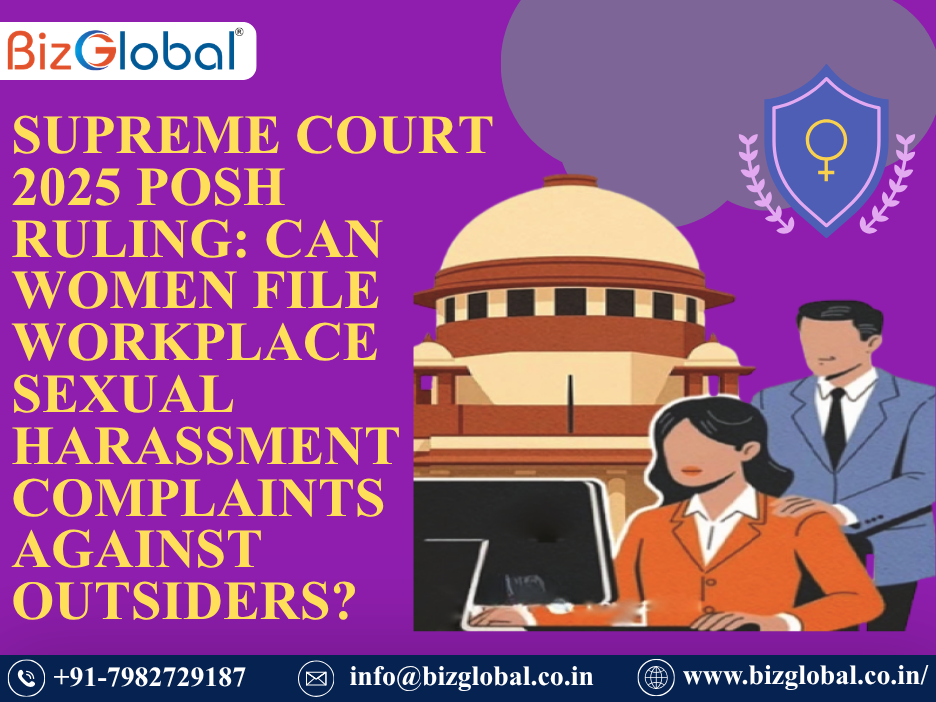
The Sexual Harassment of Women at Workplace (Prevention, Prohibition and Redressal) Act, 2013 (POSH Act) continues to evolve through judicial interpretation. In a significant development, the Supreme Court of India clarified that a woman can file a POSH complaint even against an outsider, provided the incident has a sufficient connection with her workplace.
This landmark ruling strengthens workplace safety by recognizing that sexual harassment is not limited to interactions between co-workers or employees of the same organization.
The Landmark Supreme Court Ruling
In 2025, the Supreme Court held that the protection offered under the POSH Act extends beyond harassment committed by colleagues or employees of the same organization.
The Court observed that if an incident of sexual harassment occurs in connection with the workplace, a complaint may be maintainable even when the respondent is an outsider, depending on the facts and circumstances of the case.
This interpretation broadens the protective scope of the POSH Act and reinforces its objective of ensuring safe workplaces for women.
Who Is Considered an Outsider?
An outsider may include any person who is not directly employed by the organization but interacts with employees in the course of work, such as:
- Clients or customers
- Vendors and suppliers
- Consultants from external organizations
- Contractors
- Service providers
- Visitors
- Business associates
- Delivery personnel
- Any other third party visiting or interacting with the workplace
The key consideration is whether the alleged incident occurred in relation to the workplace or employment.
Why Is This Judgment Important?
Modern workplaces involve constant interaction with third parties. Employees regularly engage with customers, vendors, consultants, and other external stakeholders.
Without this broader interpretation, women who experienced harassment by outsiders while performing their official duties could face uncertainty regarding the availability of remedies under the POSH Act.
The Supreme Court's ruling reinforces that workplace safety extends to all work-related interactions—not merely relationships between colleagues.
What Does This Mean for Employers?
The judgment increases the responsibility of employers to ensure a safe working environment even when employees interact with external individuals.
Organizations should:
- Strengthen their POSH policies to address third-party harassment.
- Ensure employees know how to report incidents involving outsiders.
- Empower the Internal Committee (IC) to examine complaints involving third parties where legally maintainable.
- Take appropriate preventive measures while dealing with clients, vendors, consultants, and visitors.
- Promote awareness regarding workplace conduct for both employees and external stakeholders.
Employers should review their existing compliance framework in light of evolving judicial interpretations.
Understanding the Scope of Workplace
The POSH Act defines "workplace" broadly. Workplace interactions may occur:
- At the employer's office.
- At client premises.
- During official travel.
- At conferences, meetings, and seminars.
- During training programmes.
- At off-site business events.
- Through virtual meetings and online communication platforms.
Where harassment occurs in connection with these work-related activities, organizations should carefully examine the applicability of the POSH Act.
Key Takeaway from the Judgment
The Supreme Court's interpretation emphasizes an important principle:
Workplace safety depends on the connection between the incident and the workplace—not merely on the employment status of the respondent.
This approach reflects the evolving nature of modern workplaces and strengthens legal protection for women across different work environments.
How  Can Help You?
At BizGlobal, we help organizations stay updated with the latest legal developments under the POSH Act and implement practical compliance measures that align with judicial interpretations.
Our services include:
- Drafting and updating POSH Policies
- Constitution and guidance for Internal Committees (IC)
- Advisory on third-party workplace harassment
- POSH compliance audits
- Complaint handling and inquiry support
- Annual compliance assistance
- Documentation and legal advisory
- End-to-end POSH consultancy for startups, MSMEs, corporates, educational institutions, hospitals, NGOs, and government organizations
We also provide professional POSH Training for employees, HR professionals, managers, leadership teams, and Internal Committee members. Our expert-led training covers evolving legal developments, third-party harassment, virtual workplace conduct, complaint procedures, and employer responsibilities under the POSH Act.
Conclusion
The Supreme Court's 2025 ruling marks another significant step in strengthening workplace safety in India. By recognizing that a POSH complaint may be maintainable against an outsider where there is a clear workplace connection, the Court has reinforced the protective purpose of the POSH Act.
Organizations should proactively update their policies, educate employees, and strengthen their compliance mechanisms to address the realities of today's workplaces.
Need expert assistance with POSH compliance?
Contact BizGlobal today at +91-7982729187 and get your POSH policy, Internal Committee setup, legal compliance advisory, complaint handling support, and professional POSH training handled by experienced experts.