
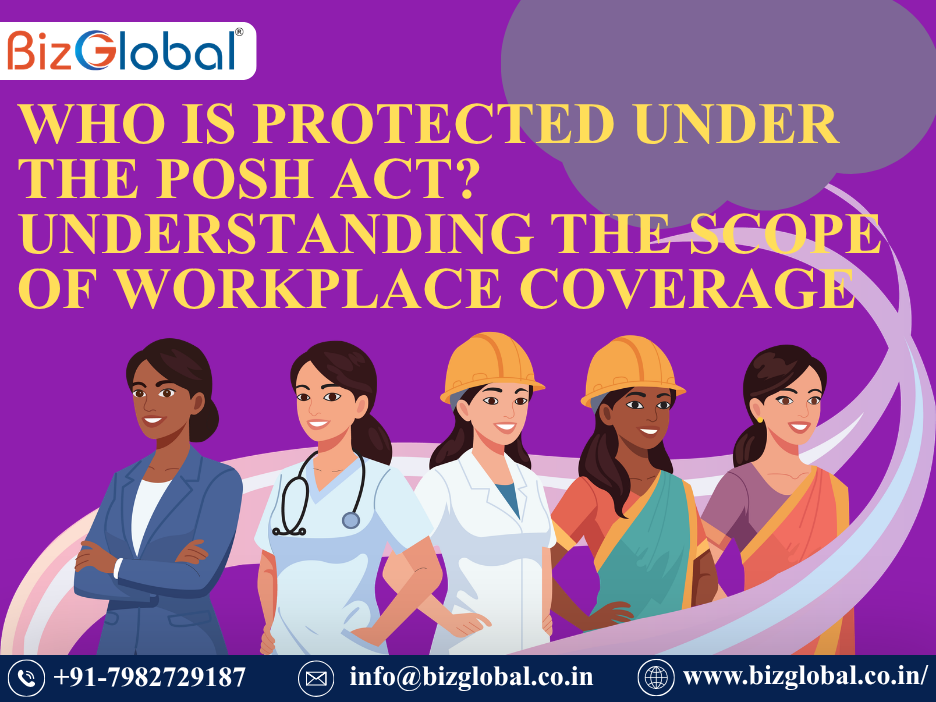
Many employers assume that the Sexual Harassment of Women at Workplace (Prevention, Prohibition and Redressal) Act, 2013 (POSH Act) applies only to permanent female employees working in offices. In reality, the Act has a much broader scope. It extends protection to women associated with an organization in various capacities and covers a wide range of workplaces, including physical and virtual environments. Understanding who is protected under the POSH Act is essential for every organization to ensure full legal compliance.
Who Is Protected Under the POSH Act?
The POSH Act protects every woman, irrespective of her age or employment status, who alleges that she has been subjected to sexual harassment at a workplace.
Protection is not limited to permanent employees. It extends to women engaged with an organization in multiple capacities.
Categories of Women Protected Under the POSH Act
The Act covers women working in or associated with an organization as:
1. Permanent Employees
Women employed on a full-time basis are protected under the provisions of the POSH Act.
2. Temporary Employees
Women engaged for a fixed duration or temporary assignments enjoy the same legal protection against workplace sexual harassment.
3. Contractual Employees
Employees hired through contractors or third-party agencies are also covered under the Act while working at the organization.
4. Daily Wage Workers
Women working on daily wages or casual employment are equally entitled to a safe and respectful workplace.
5. Interns and Trainees
Whether paid or unpaid, interns, apprentices, and trainees are protected under the POSH Act during their engagement with the organization.
6. Consultants and Professionals
Women serving as consultants, advisors, freelancers, or independent professionals are covered while performing work-related assignments.
7. Volunteers
Women participating as volunteers for an organization are entitled to protection under the Act.
8. Domestic Workers
The POSH Act also recognizes domestic workers and provides protection against sexual harassment in the course of their employment.
Which Organizations Must Comply?
Every organization employing 10 or more employees is legally required to comply with the POSH Act.
This includes:
- Private companies
- Public sector undertakings
- Government offices
- Educational institutions
- Hospitals and healthcare facilities
- Hotels and hospitality businesses
- NGOs and non-profit organizations
- Startups and MSMEs
- Factories and manufacturing units
- Corporate offices and business establishments
Regardless of industry, employers are responsible for creating a safe working environment.
What Is Considered a Workplace Under the POSH Act?
One of the most important aspects of the POSH Act is its broad definition of a workplace. Protection is not confined to the employer's office premises.
A workplace may include:
- Corporate offices and branches
- Client locations
- Government departments
- Educational institutions
- Hospitals and healthcare facilities
- Factory premises
- Work-related travel
- Transportation provided by the employer
- Business meetings, conferences, and seminars
- Off-site training programs
- Company-sponsored events
- Hotels or venues used for official purposes
- Work-from-home arrangements
- Virtual workplaces and online meetings
- Digital communication platforms used for work
The inclusion of remote and virtual work environments highlights the Act's relevance in today's hybrid and digital workplaces.
Why Understanding Coverage Is Important?
Many organizations unintentionally overlook individuals such as interns, consultants, contractual workers, or remote employees when implementing POSH compliance measures.
However, failing to extend awareness, training, and grievance mechanisms to all covered individuals may expose the organization to legal and reputational risks.
A comprehensive POSH framework should protect everyone associated with the workplace, regardless of their employment arrangement.
How  Can Help You?
At BizGlobal, we provide complete POSH compliance solutions that help organizations meet their legal obligations while building a respectful and inclusive workplace culture.
Our services include:
- Drafting and implementation of POSH Policies
- Formation and guidance for Internal Committees (IC)
- POSH compliance audits
- Complaint redressal advisory
- Annual compliance support
- Documentation and legal assistance
- End-to-end POSH consultancy for startups, MSMEs, corporates, educational institutions, and NGOs
We also provide professional POSH Training for employees, HR professionals, managers, senior leadership, and Internal Committee members. Our training programs are designed to increase awareness, prevent workplace harassment, and ensure organizations remain fully compliant with the POSH Act.
Conclusion
The POSH Act protects far more than just permanent employees—it safeguards every woman associated with a workplace, regardless of her role or employment status. From interns and consultants to contractual staff and remote workers, organizations must ensure that every individual has access to a safe, respectful, and harassment-free work environment.
Implementing comprehensive POSH compliance is not only a legal obligation but also a reflection of an organization's commitment to equality, dignity, and employee well-being.
Need expert assistance with POSH compliance?
Contact BizGlobal today at +91-7982729187 and get your POSH policy, Internal Committee setup, compliance advisory, documentation, and professional POSH training handled by experienced experts.