
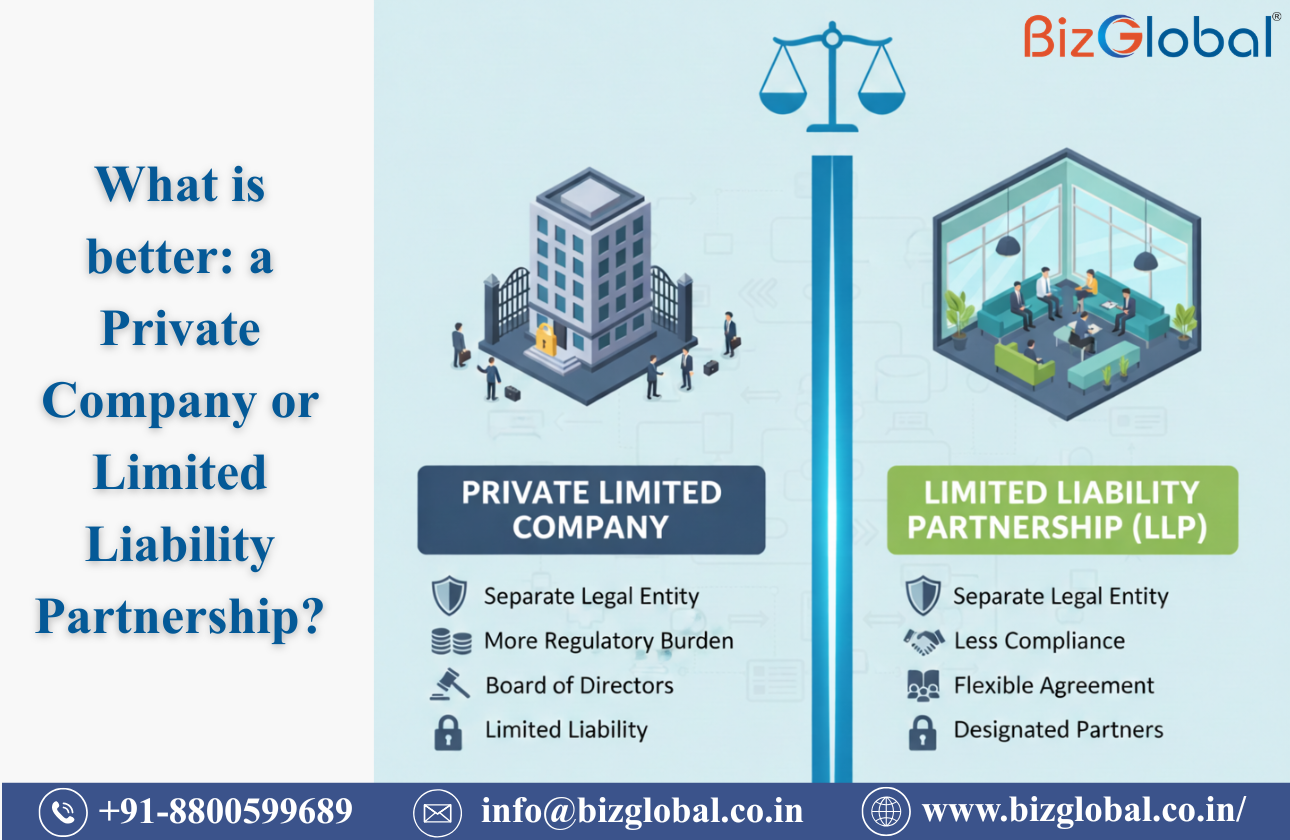
When starting a business in India, one of the most common questions entrepreneur faces is to what type of organization to choose for their business. Whether a Private Limited company is feasible? Is LLP cheaper than Private Limited Company? What is better: a Private Company or Limited Liability Partnership?
Let us first understand the meaning of these organizations.
A Private Limited Company is a business structure registered under the Companies Act, 2013, where the company is treated as a separate legal entity from its owners. It is owned by shareholders and managed by directors, and the liability of members is limited to the value of their shares. On the other hand, a Limited Liability Partnership (LLP) is registered under the LLP Act, 2008 and combines the benefits of a traditional partnership with limited liability protection. In an LLP, partners directly manage the business, and their liability is limited to their agreed contribution, making it a flexible and less compliance-heavy structure.
Both these structures offer limited liability, are treated as separate legal entity, require registration with the Ministry of Corporate Affairs, and possess perpetual succession. Both are subject to formal compliance, including annual filings and tax regulations. The business and personal finances must be kept separate for transparency. A minimum number of two members (shareholders or partners) are required in both these structures for formation.
But the question still remains the same – which structure is better?
Understanding the differences between these structures at the beginning can help entrepreneurs avoid future complications and select a structure that aligns with their long-term goals. This comparison aims to clearly explain the key aspects of Private Limited Companies and LLPs, making it easier for entrepreneurs to make an informed and confident decision.
|
Particular |
Private Limited Company |
Limited Liability Partnership |
|
Governing Law |
Companies Act 2013 |
Limited Liability Partnership Act 2008 |
|
Certificate of Commencement of Business |
Obtaining certificate of commencement of business is mandatory. |
Obtaining certificate of commencement of business is not mandatory. |
|
Taxation |
It is a separate taxable entity. |
It’s taxation is similar to partnership. |
|
Dividend Distribution Tax |
It may involve additional tax considerations when distributing profits. |
LLPs are not required to pay dividend distribution tax |
|
Liability |
Liability of members is only limited to the shares held by them. |
Liability of partners is limited upto their capital contribution however in case a partners acts with an intension to conduct fraud, they are personally liable. |
|
Transfer of Shares |
Shares can be easily transferred by amending AOA. |
Transfer of partnership rights may require the consent of other partners and is generally more complex. |
|
ESOPs |
Can issue ESOPs to the Employees. |
Unable to issue ESOPs to the Employees. |
|
Manner of keeping Books of Accounts |
Accrual Basis |
Cash Basis or Accrual Basis |
|
Maximum number of Member |
Maximum 200 members in case of Private Company |
No cap of maximum number of its partners |
|
Compliance Requirements |
A Private Limited Company has higher compliance requirements. |
An LLP has simpler compliance. |
|
Fundraising |
They are more suitable for startups and growing businesses. They can raise funds from venture capitalists, angel investors, and issue shares or ESOPs |
LLPs are generally not preferred by investors because they cannot issue shares. |
In conclusion, both a Private Limited Company and an LLP are effective business structures, but they serve different purposes. A Private Limited Company is ideal for entrepreneurs who aim for rapid growth, investor funding, and strong market credibility, while an LLP suits businesses that prefer operational flexibility, lower compliance, and simpler management. There is no one-size-fits-all choice, the right structure depends on your business vision, scale, compliance capacity, and long-term goals. By carefully evaluating these factors at the outset, entrepreneurs can lay a solid legal and financial foundation for sustainable and successful business growth.