
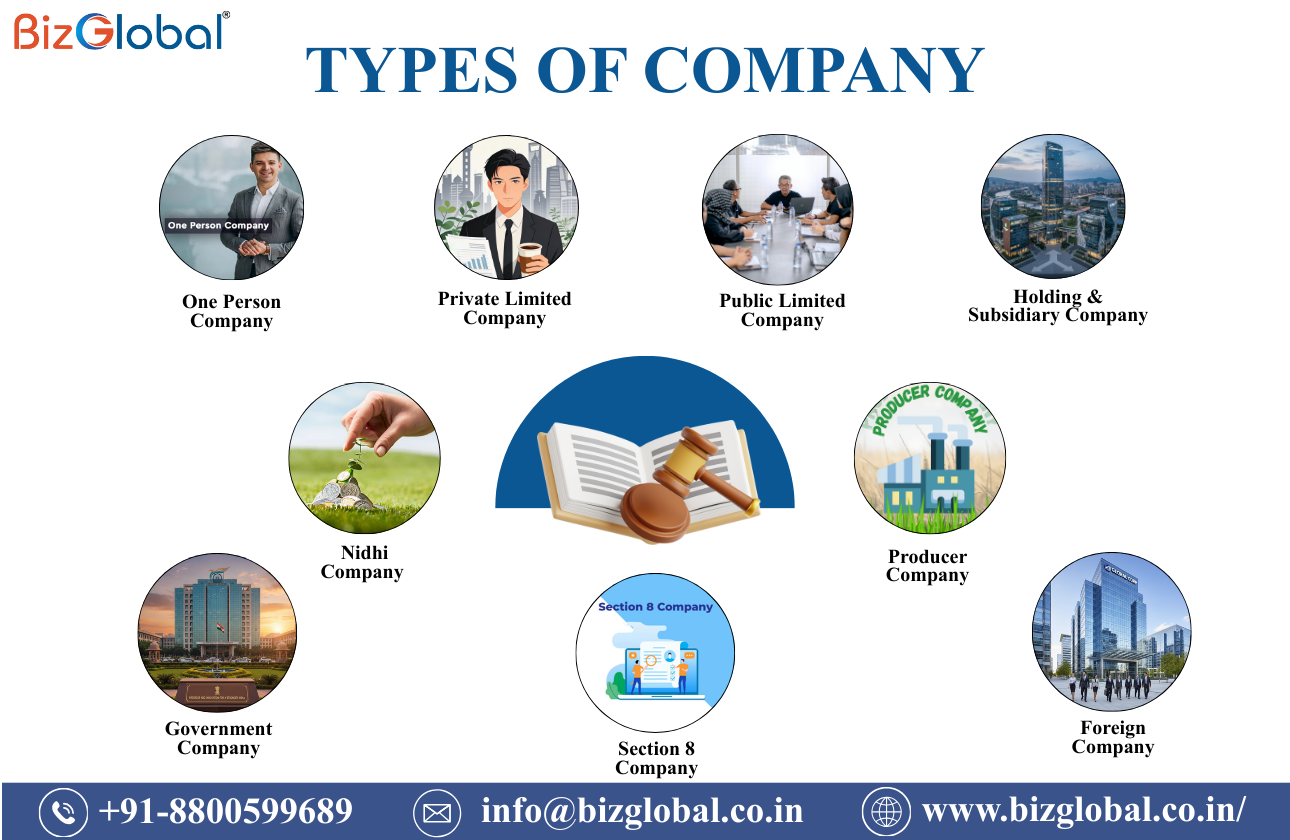
Starting a business in India is not just about having a great idea, it is about choosing the right legal foundation, which often brings one important question - what is a company and which type should you choose? How is it different from a sole proprietorship or partnership? And which type of company is best suited for your business goals?
Choosing the right type of company is not merely a procedural decision — it directly impacts your taxation, compliance obligations, fundraising capacity, liability protection, and long-term scalability. Whether you are a startup founder, a solo entrepreneur, a growing enterprise, or a non-profit organization, understanding the types of companies available in India is essential before incorporation.
Let’s break it down in simple terms.
What is a Company?
According to Section 2(20) of the Companies Act, 2013, a “company” means a company incorporated under the Companies Act, 2013 or under any previous company law. The Companies Act, 2013 governs all listed and unlisted companies in the country.
A company is a legal business entity registered under the Companies Act, 2013 in India. It is formed by one or more persons to carry on a lawful business with the objective of earning profit or achieving a specific purpose. A company has a separate legal identity, which means it is different from its owners (shareholders and directors).
Why you should incorporate a company?
If you are still operating without incorporation, consider the following:
- Separate Legal Entity: A company exists independently of its members.
- Better Funding Opportunities: Investors prefer investing in structured entities like Private Limited Companies. Venture capital funding, angel investment, and equity funding are possible only in certain structures.
- Limited Liability: The liability of shareholders is limited to the amount invested in shares.
- Higher Credibility: Clients, banks, and government departments prefer dealing with registered companies. Incorporation increases trust and professional image.
- Perpetual Succession: The company continues even if ownership changes.
- Artificial Legal Person: A company is created by law and operates through its directors.
- Easy Ownership Transfer: Ownership can be transferred easily, subject
Types of companies in India
A. Types of Companies on the basis of size or number of members in a company
The Act introduced the concept of a One Person Company (OPC). As per the Act, an OPC is a company that has only one member. The member can also be the director of the company. Though the OPC has only one member, it can have a maximum of 15 directors. It is suitable for solo entrepreneurs. Ideally it is opted by small business owners who want corporate status without partners.
This is the most preferred structure for startups and growing businesses. According to Section 2(68) of the Companies Act, 2013, “private company” means a company having minimum paidup share capital as may be prescribed and which, by its articles, restricts the right to transfer of its shares. It can have maximum of 200 members. It shall have a minimum of two directors. This type of company boosts investor confidence in the organization. So, if you are planning long-term growth, external investment or scaling operation, this is usually the best choice.
This structure is suitable for large-scale businesses planning to raise funds from the public. As per Section 2(71) of the Companies Act, 2013, “public company” means a company that is not classified as a private company and has a minimum paid-up share capital as prescribed by law. In simple words, a company where the general public can hold the company shares. There is no maximum shareholders limit for a public limited company, but there needs to be a minimum of seven members to establish a public company. The company needs to have three directors and can have a maximum of fifteen directors. Unlike private company, this structure comes with higher compliance but offers massive capital potential.
A.4 Small Company
Small companies form the backbone of India’s economy. However, applying the same compliance burden to both large corporations and small startups created unnecessary regulatory pressure. To reduce compliance burden for genuinely small businesses, the government introduced the concept of a “Small Company” under the Companies Act, 2013. As per Section 2(62) of the Act, “small company” means a company, other than a public company which has: –
- Paid up share capital of not more than 10 Crore rupees, and
- Turnover of which as per its last profit and loss account does not exceed 100 crores rupees.
This classification provides relaxed compliance requirements and operational ease, making it highly beneficial for startups and small entrepreneurs. If you are planning to incorporate a Private Limited Company, qualifying as a Small Company can significantly reduce your compliance pressure in the initial years.
B. Types of Companies on the basis of Control
B.1 Holding Company
A holding company is a company having the majority of voting powers of another company (called subsidiary company). As per Section 2(46) of the Companies Act, 2013, “holding company” in relation to one or more companies, means a company of which such companies are subsidiary companies. The holding company is like the parent company controlling the subsidiary company’s policies, assets and management decisions. However, it remains uninvolved in the subsidiary’s day-to-day activities. If the parent company owns all the shares of the other company, it’s called wholly-owned subsidiary.
A company can become a holding company in two ways:
- By buying enough shares in another company to have control over it.
- By starting a new company and keeping some or all of its shares.
B.2 Subsidiary Company
As per Section 2(87) of the Companies Act, 2013, “subsidiary company” is a company that is controlled by another company, called the holding company. A subsidiary company is owned and controlled by another company (holding company) either partially or entirely. The holding company controls the composition of the board of directors of the subsidiary company or more than 50% of its voting powers.
- Where a single holding company holds 100% voting powers, the subsidiary is known as the Wholly Owned Subsidiary (WOS) of the holding company.
- A deemed subsidiary is a company considered to be under the control of a holding company, even if that control comes from another subsidiary of the holding company.
B.3 Associate Company
An Associate Company is defined under the Companies Act, 2013 as a company in which another company has significant influence, but which is not a subsidiary company. Significant influence generally means control of at least 20% of the total voting power or participation in business decisions under an agreement, without having majority control over the Board of Directors. In simple terms, it represents a strategic investment relationship where one company holds a substantial stake and can influence key decisions of another company, yet does not exercise full control. The concept of an associate company is important for financial reporting, consolidated accounts, and regulatory compliance, as it reflects partial ownership and collaborative business arrangements rather than complete ownership.
C. Types of Company Based on Liability
C.1 Limited by Shares
A company limited by shares means the liability of the company members is limited by the Memorandum of Association (MOA). The company members are liable only for the unpaid amount on the shares respectively held by them. The equity shares held by a member measure the shareholder’s ownership in the company.
C.2 Limited by Guarantee
A company limited by guarantee means the member’s liability is limited to the amount they guarantee to contribute towards the company’s assets. The member’s liability is limited by the company MOA. The members undertake in the MOA to contribute the guaranteed amount in the event of the company being wound up. The percentage of the member’s ownership is based on the amount guaranteed by them.
C.3 Unlimited Company
An unlimited company means the company members do not have any limit on their liability. If any debt arises, the member’s liability is unlimited and extends to their personal assets. Usually, the company entrepreneurs choose not to incorporate this type of company.
D. Types of Company Based on Listing
D.1 Listed Company
A listed company is a company which is registered on various recognised stock exchanges within or outside India. The shares of the listed companies are freely traded on the stock exchanges. They have to follow the guidelines given by the Securities Exchange Board of India (SEBI).
A company that wishes to list its shares on stock exchanges should issue a prospectus to the general public for subscribing to its debentures or shares. A company can list its shares through an Initial Public Offer (IPO), while an already listed company can make a Further Public Offer (FPO).
D.2 Unlisted Company
An unlisted company is a company that is not listed on any recognised stock exchange, and its shares are not freely tradable on the stock exchanges. These companies fulfil their capital requirements by obtaining funds from friends, family members, relatives, financial institutions, or private placement. An unlisted company must convert to a public company and issue a prospectus if it wishes to list its securities on the stock exchanges.
E. Special Companies
E.1 Government Company
A Government Company is defined under the Companies Act, 2013 as a company in which not less than 51% of the paid-up share capital is held by the Central Government, State Government, or jointly by both. These companies operate like corporate entities but are controlled by the government to serve public interest and strategic sectors such as energy, infrastructure, defense, and heavy industries. Examples include Oil and Natural Gas Corporation and Bharat Heavy Electricals Limited. Government companies combine commercial objectives with public accountability and play a significant role in national economic development.
An association of persons or individuals can register a company under Section 8 of the Act for charitable purposes. These companies are established to promote commerce, science, art, education, sports, research, religion, social welfare, charity, the protection of the environment, or such other objects. The company should apply its profits and other incomes to promote its activities. Such companies intend to prohibit any dividend payments to their members. This structure offers credibility, structured governance, and better transparency compared to trusts or societies, making it suitable for NGOs and social enterprises.
E.3 Nidhi Company
A Nidhi Company is a type of Non-Banking Financial Company (NBFC) recognized under the Companies Act and regulated by the Ministry of Corporate Affairs. Its primary objective is to cultivate the habit of thrift and savings among its members. A Nidhi Company can accept deposits from and lend money only to its members. It cannot deal with the general public for lending or deposit activities. This structure is suitable for small financial mutual benefit activities within a closed group and is commonly formed in the form of a Public Limited Company with specific compliance requirements.
E.4 Producer Company
A Producer Company is formed by farmers, agriculturists, or primary producers for carrying out activities related to production, harvesting, procurement, grading, pooling, marketing, selling, or export of primary produce. It blends the cooperative model with corporate governance principles and is registered under the provisions of the Companies Act, 2013. The main objective of a Producer Company is to improve income and welfare of its members by enabling collective bargaining and structured management. It is particularly beneficial for agriculture-based communities seeking organized growth and better market access.
E.5 Foreign Company
A Foreign Company is a company incorporated outside India but having a place of business in India through a branch office, liaison office, project office, or electronic mode. Such companies are required to comply with specific provisions of the Companies Act, 2013 relating to registration, filing of documents, and financial disclosures. Foreign companies typically enter India to expand operations, execute contracts, or explore market opportunities while maintaining their primary incorporation outside the country. They must also comply with FEMA regulations and other sector-specific laws applicable in India.
Conclusion
Whether you opt for a Private Limited Company for scalability, an OPC for independent control, or a Section 8 Company for social impact, each structure serves a specific strategic purpose under the Companies Act, 2013. Incorporation provides more than registration, it offers credibility, limited liability protection, structured governance, and access to growth opportunities that informal business setups simply cannot match. It protects your personal assets, strengthens investor confidence, and positions your business for long-term expansion.
If you are serious about building a sustainable and professionally managed enterprise, the right time to incorporate is now. A strong legal foundation today ensures stability, compliance, and scalability tomorrow.
At BizGlobal, we simplify the entire incorporation process, from choosing the right company structure to documentation, government filings, compliance guidance, and post-registration support. Our team ensures accurate filing, timely approvals, and strategic advice tailored to your business goals. Whether you are a startup founder, a growing entrepreneur, or planning a structured expansion, BizGlobal helps you incorporate confidently and compliantly so you can focus on building your business while we handle the legal foundation