
The food business landscape in India has always been dynamic, but the latest amendment introduced by the Food Safety and Standards Authority of India in March 2026 brings a fresh wave of clarity, flexibility, and accountability. At first glance, regulatory updates may seem technical or distant from everyday business realities, but this particular amendment has a direct impact on thousands of small vendors, startups, and established food operators across the country. It is not just a legal update; it is a reflection of how India’s food ecosystem is evolving to become more inclusive while tightening its grip on safety and compliance.
The amendment, officially titled the Food Safety and Standards (Licensing and Registration of Food Businesses) Amendment Regulations, 2026, modifies the earlier 2011 framework that governed licensing and registration. What makes this update significant is the way it balances ease of doing business with stricter compliance expectations. It acknowledges the realities of small food businesses while ensuring that food safety does not take a back seat.
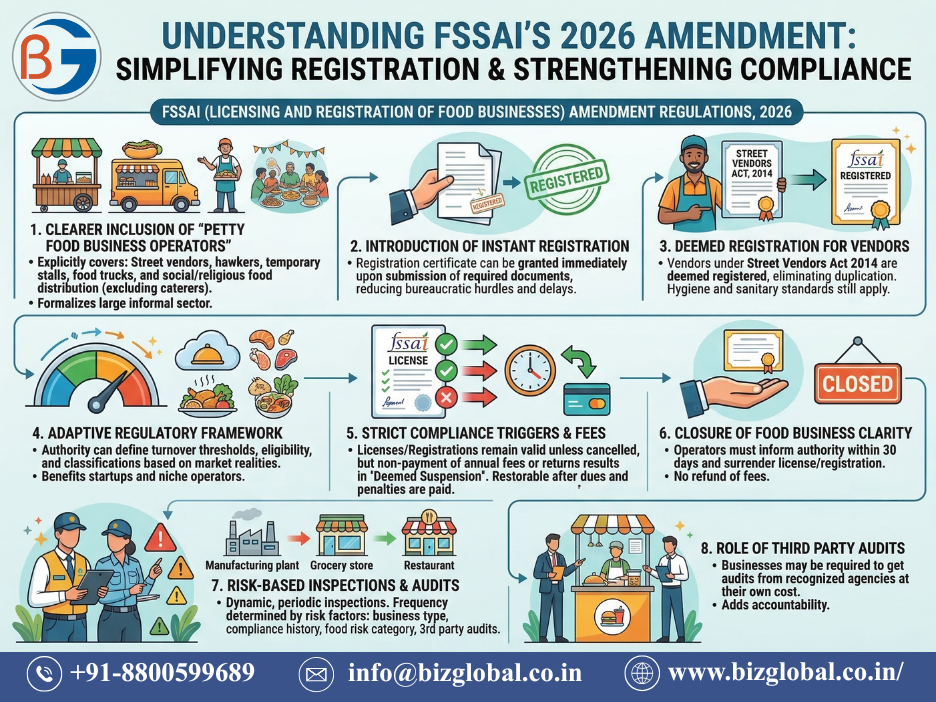
1. One of the most notable changes is the expanded definition of a “petty food business operator.”
“Petty Food Business Operator” means any food business operator, who manufactures or sells any article of food himself or a petty retailer, street food vendor, hawker, itinerant vendor or temporary stall holder or food truck or distributes foods including in any religious or social gathering, except a caterer or such other food business including small scale or cottage or such other industries relating to food business or tiny food business.
Earlier, the category existed but was not as clearly inclusive. Now, it explicitly covers street vendors, hawkers, food truck operators, temporary stall owners, and even those distributing food during religious or social gatherings, except caterers. By clearly identifying and including these segments, the regulation formally brings a large informal sector under the compliance umbrella.
2. Another major shift is the introduction of a provision for instant registration. The authority now has the power to grant a registration certificate immediately upon submission of required documents, subject to conditions it may specify. For small business owners, especially first-time entrepreneurs, this is a game changer. Anyone who has tried to start a food business knows that delays in approvals can be frustrating and costly. This move signals a clear intent to reduce bureaucratic hurdles and encourage quicker formalization of food businesses.
3. Equally interesting is the treatment of street vendors under the new amendment. Vendors who are already registered under the Street Vendors Act of 2014 are now deemed to be registered under the food safety law as well. This eliminates duplication and reduces compliance burden. However, this does not mean they are free from responsibility. They are still required to follow hygiene and sanitary standards outlined in the regulations. This dual approach of simplification with accountability shows a thoughtful regulatory design.
4. The amendment also introduces more flexibility for the authority itself. It can now define turnover thresholds, eligibility criteria, and classification methods for different types of food businesses from time to time. Instead of being stuck with rigid rules, the authority can adapt its framework based on market realities. This could benefit startups, cloud kitchens, and niche food operators who often fall into grey areas under traditional classifications.
5. Another crucial area addressed is the validity and status of licenses and registrations. Under the revised rules, a license or registration remains valid unless it is suspended, cancelled, or surrendered. However, there is a strong compliance trigger built into the system. If a business fails to pay its annual fee or submit required returns, the license is automatically deemed suspended. This is a serious shift because it places the responsibility squarely on the business operator. During the suspension period, the operator is not allowed to carry out any food-related activity, and any violation can attract penalties.
This change may appear strict, but it actually promotes discipline within the system. Earlier, delays in renewals or filings could sometimes go unnoticed or unaddressed. Now, the consequences are immediate and clear. At the same time, the provision allows for restoration once the dues are cleared and penalties, if any, are paid. So, it is not punitive for the sake of it but rather corrective in nature.
6. The amendment also brings clarity to what happens when a food business shuts down. Operators are now required to inform the authorities within thirty days and surrender their license or registration. Importantly, no refund of fees is allowed in such cases. This ensures that records remain updated and the regulatory system reflects the actual number of active businesses.
7. Perhaps the most impactful addition is the introduction of a structured inspection and audit framework. The authority will conduct periodic inspections either directly or through authorized agencies. These inspections will not be random but based on a dynamic risk-based approach. Factors like the type of food business, past compliance history, third party audit results, and the risk category of food handled will determine how often and how rigorously a business is inspected.
This is a modern approach to regulation. Instead of treating all businesses the same, it focuses resources where the risk is higher. For example, a large food manufacturing unit handling perishable items may face more frequent checks than a low-risk operator. This ensures better use of regulatory capacity while maintaining high safety standards.
8. Another important feature is the role of third party audits. Businesses may be required to get their food safety audits done by recognized agencies at their own cost. This introduces an additional layer of accountability and professionalism. It also opens up opportunities for specialized auditing firms in the food safety domain.
Overall, the 2026 amendment is not just about adding new rules. It is about reshaping how food safety regulation works in India. It recognizes that the food sector is diverse, ranging from roadside vendors to large corporations, and that a one size fits all approach does not work anymore. By combining ease of registration, clear definitions, strict compliance triggers, and risk-based monitoring, the amendment creates a more balanced and effective system.
For business owners, the message is clear. Entering the food industry is becoming easier, but staying compliant is more important than ever. The system is designed to support growth, but it also expects responsibility. For consumers, this update brings a sense of reassurance. Behind every meal, whether from a street vendor or a restaurant, there is a stronger framework working to ensure safety and hygiene.
In the end, this amendment reflects a broader shift in governance. It is not just about controlling businesses but enabling them while safeguarding public health. And in a country where food is deeply connected to culture, livelihood, and daily life, that balance matters more than ever