
The Food Safety and Standards Authority of India has introduced an important update that will directly impact thousands of food businesses across the country. This is not an isolated decision. It stems from recommendations made by a high-level committee of NITI Aayog, which focused on reducing non-financial regulatory burdens. Through its latest order dated 13 March 2026, the authority has revised the turnover thresholds that determine whether a food business needs basic registration, a state license, or a central license. While this may sound like a technical compliance change at first glance, it actually reflects a broader shift towards simplifying regulations and making them more practical for businesses of different sizes.
To understand why this matters, it helps to look at how food businesses have traditionally been categorized. Under the Food Safety and Standards framework, every food business operator must either register or obtain a license depending on their size and scale of operations. These categories are not just labels. They define the level of compliance, documentation, and regulatory scrutiny a business must follow. Until now, many businesses found themselves confused or even burdened by thresholds that did not always reflect the realities of modern food operations.
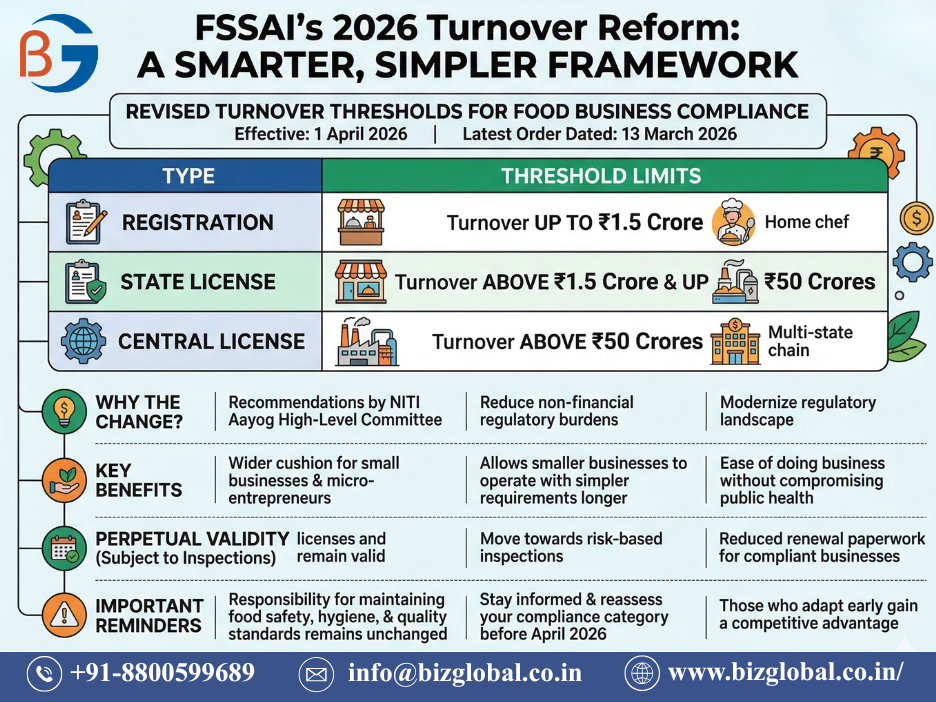
With the new update, FSSAI has clearly redefined these categories based on turnover. In exercise of the powers conferred, the Food Authority hereby implemented revised turnover threshold for food businesses as follows:
|
Type |
Threshold Limits |
|
Registration |
Turnover up to Rs. 1.5 crore |
|
State License |
Turnover above Rs. 1.5 crore and up to Rs. 50 crores |
|
Central License |
Turnover above Rs. 50 crores |
These revised limits will come into effect from 1 April 2026, replacing all previous criteria related to turnover classification.
At a practical level, this change brings relief, especially to small and growing businesses. Many startups, home-based food operators, and small vendors often struggled to understand whether they had crossed the threshold for a higher category. The new ₹1.5 crore limit for registration provides a wider cushion, allowing smaller businesses to operate with simpler compliance requirements for longer. This is particularly helpful in a country like India, where the food sector includes a vast number of micro-entrepreneurs. By aligning regulatory thresholds with actual business growth patterns, the authorities are trying to strike a balance between compliance and convenience.
The update is also linked to broader reforms introduced through the 2026 amendment to the Food Safety and Standards (Licensing and Registration of Food Businesses) Regulations. One of the key highlights of these amendments is the move towards perpetual validity of licenses and registrations, subject to risk-based inspections. This means that instead of repeatedly renewing licenses, businesses will be monitored based on their risk profile. For compliant businesses, this could significantly reduce paperwork and administrative hassle.
However, it is important to note that while compliance may become simpler in terms of categorization, the responsibility of maintaining food safety standards remains unchanged. Whether a business is registered or licensed, it must still adhere to hygiene, quality, and safety norms prescribed by FSSAI. In fact, with the introduction of risk-based inspections, authorities may focus more closely on businesses that pose higher risks, making compliance quality even more important.
For consultants, compliance professionals, and firms working in this space, this update opens up new opportunities as well. Businesses will need guidance to reassess their current category, understand the implications of the new thresholds, and ensure that their documentation and processes are aligned with the updated regulations. It is also a good time for businesses to review their internal systems and prepare for a more dynamic compliance environment.
In conclusion, this update by FSSAI is more than just a numerical revision of turnover limits. It reflects a shift towards smarter regulation, where the focus is on ease of doing business without compromising public health. By widening the registration threshold, simplifying licensing requirements, and introducing structural reforms, the authority is making a conscious effort to modernize the regulatory landscape.
For food business operators, the message is clear. Stay informed, reassess your compliance category before April 2026, and use this change as an opportunity to streamline your operations. Regulations are evolving, but they are also becoming more business-friendly. Those who adapt early will not only remain compliant but also gain a competitive advantage in an increasingly organized food sector.